Consumers today are surrounded by advertisements.
Thank you for reading this post, don’t forget to subscribe!Every time someone opens Instagram, Facebook, YouTube, or another social platform, they see brands competing for attention.
Polished product photographs and professionally produced advertisements still have an important place in marketing. But customers increasingly want something else as well:
Real people using real products in real situations.
This is where UGC marketing for brands becomes powerful.
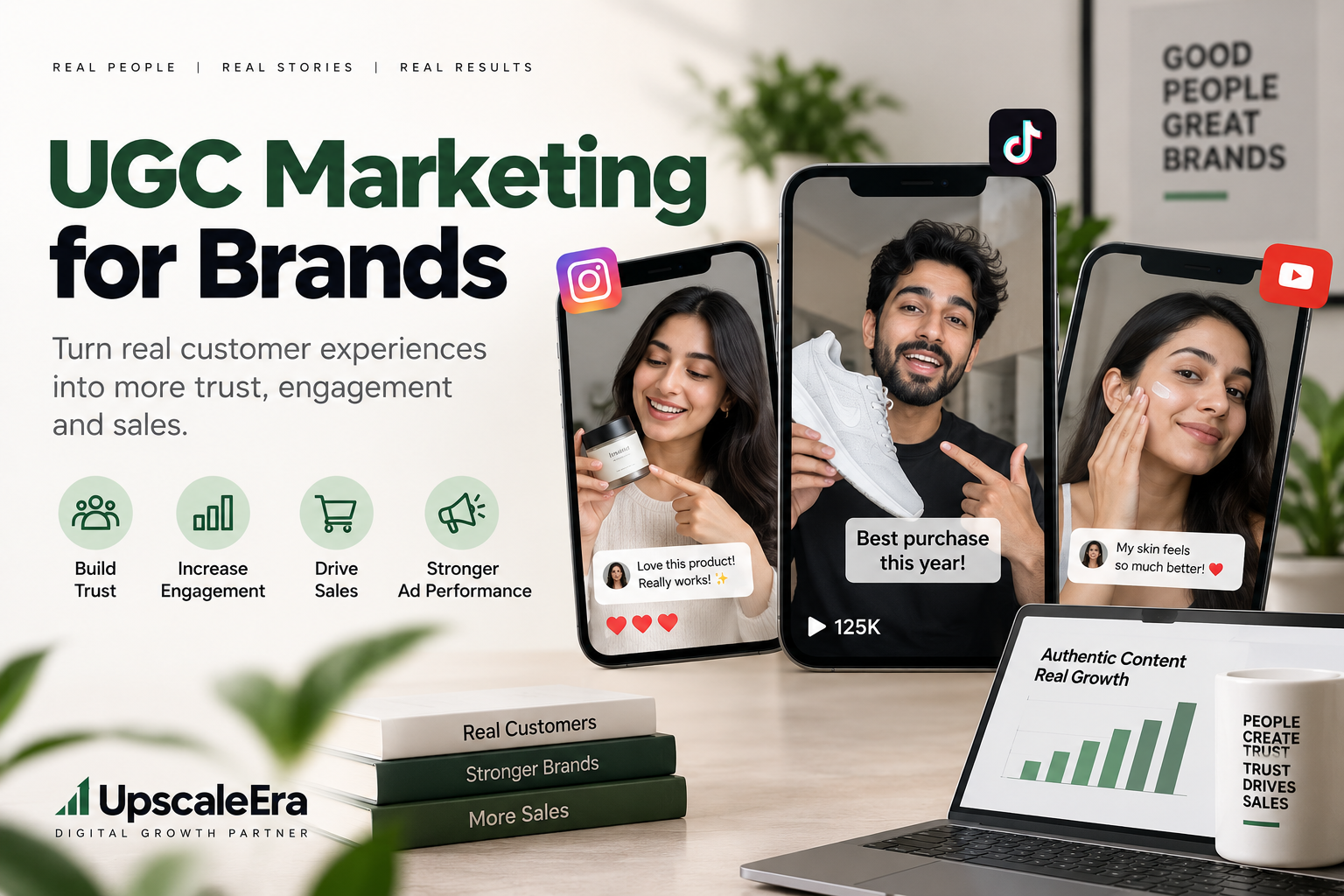
User-generated content, commonly known as UGC, helps businesses show products through the experiences of customers, creators, and everyday users.
Instead of a brand simply saying:
“Our product is amazing.”
UGC allows potential customers to see someone actually using it, explaining it, reviewing it, or sharing their experience.
For ecommerce and D2C businesses, this can help build trust, strengthen advertising creatives, increase engagement, and support conversions.
In this guide, we will explain how UGC works, why brands use it, and how you can build a strong UGC strategy.
What Is UGC Marketing?
UGC stands for User-Generated Content.
It refers to content created by customers, users, fans, or creators that features or discusses a brand, product, or service.
UGC can include:
- Customer photos
- Product videos
- Testimonials
- Unboxing videos
- Reviews
- Instagram Stories
- Reels
- Product demonstrations
- Before-and-after content
- Tutorials
- Social media mentions
- Customer experiences
UGC marketing for brands is the process of strategically using this type of content across marketing channels.
That could mean using UGC on:
- Meta Ads
- Product pages
- Landing pages
- Email campaigns
- Websites
- YouTube
- Retargeting campaigns
The goal is to make the brand feel more trustworthy, relatable, and customer-focused.
Why Is UGC Marketing Important for Brands?
Traditional advertising is usually controlled entirely by the brand.
The business decides:
- What the product looks like
- What message is communicated
- How the advertisement is filmed
- Who appears in it
- What claims are highlighted
UGC changes the perspective.
Instead of seeing only a company’s message, customers see the product from another person’s point of view.
That can make the content feel more natural.
A skincare company, for example, may create a studio advertisement showing the bottle.
UGC could instead show a customer saying:
“Here’s how I use this product in my morning routine.”
Both types of content can be useful, but they achieve different things.
Traditional creative gives the brand control.
UGC adds relatability and social proof.
1. UGC Builds Trust
Trust is one of the biggest barriers in online shopping.
Customers may wonder:
- Does this product really work?
- Is the quality good?
- Will it look the same when delivered?
- Is this company trustworthy?
- Are these reviews genuine?
- Is the product right for me?
Good UGC marketing for brands helps answer these questions visually.
When potential customers see other people using a product, the purchase feels less uncertain.
For example, an ecommerce luggage brand can show professional studio photos of a suitcase.
But UGC can show:
- Someone packing the suitcase
- A traveler using it at an airport
- Wheel movement
- Storage capacity
- Compartments
- Real-world product size
That gives customers information that a polished product image may not communicate.
2. UGC Acts as Social Proof
People often look at other people’s experiences before making purchasing decisions.
This is why:
- Reviews
- Ratings
- Testimonials
- Customer photos
- Video reviews
are important ecommerce assets.
UGC works like visual social proof.
Instead of simply reading:
“Excellent product.”
customers can see someone interacting with the product.
This makes UGC marketing for brands particularly valuable for products where demonstration matters.
Examples include:
- Beauty products
- Skincare
- Fashion
- Luggage
- Home products
- Food
- Fitness products
- Baby products
- Electronics
- Accessories
3. UGC Makes Advertising Feel More Natural
Some traditional advertisements immediately look like advertisements.
Users may scroll past them without paying attention.
UGC-style ads can feel closer to normal social content.
A creator speaking directly to the camera might begin with:
“I wasn’t expecting this to solve one of my biggest travel problems…”
That style can create curiosity before the viewer even realizes they are watching branded content.
UGC advertising frequently uses:
- Talking-head videos
- Product demonstrations
- Personal stories
- Unboxing
- Problem-solution formats
- Testimonials
- Before-and-after formats
- Voiceovers
The key is making the content feel natural without misleading viewers about its commercial nature.
4. UGC Helps Explain Products
A product page may contain:
- Images
- Features
- Specifications
- Description
But sometimes customers still don’t fully understand the product.
Video UGC can demonstrate it much faster.
For example, instead of writing:
“360-degree wheels for easier movement.”
a video can simply show the suitcase moving smoothly in different directions.
Instead of saying:
“Easy to apply.”
a beauty brand can show someone actually using the product.
Strong UGC marketing for brands therefore works as both marketing and product education.
5. UGC Can Improve Product Pages
UGC should not be limited to social media.
Ecommerce websites can also use it.
UGC on product pages can include:
- Customer image galleries
- Video testimonials
- Review videos
- Customer photos
- Before-and-after examples
- Product demonstrations
Think about the customer’s journey:
Ad → Product Page → Reviews → UGC → Purchase
A customer who is uncertain may receive additional reassurance after seeing how real users experience the product.
UGC vs Influencer Marketing: What’s the Difference?
UGC and influencer marketing are related, but they are not the same.
Influencer Marketing
The primary value usually comes from the creator’s audience and reach.
The brand collaborates with someone who already has followers.
The influencer publishes the content to their audience.
UGC Marketing
The main value comes from the content itself.
A UGC creator does not necessarily need a huge following.
Brands may hire creators specifically to make content that the company can use in:
- Ads
- Website
- Product pages
- Reels
- Social posts
For example:
A creator with 2,000 followers could make an excellent product demonstration.
The brand might then use that video in Meta Ads and reach hundreds of thousands of people.
The creator’s audience size is less important because the brand controls the distribution.
Organic UGC vs Paid UGC
There are two broad types of UGC.
Organic UGC
Organic UGC happens when customers create content naturally.
Examples:
- Customer tags your brand
- Customer uploads an unboxing
- Customer posts a review
- Customer shares a Story
This is valuable because it comes from genuine customer enthusiasm.
Paid UGC
Paid UGC usually involves hiring creators to produce content for the brand.
The brand provides:
- Product
- Brief
- Key message
- Content requirements
- Usage requirements
The creator produces UGC-style content.
Paid UGC gives brands more consistency and control over content production.
What Makes a Good UGC Video?
A strong UGC video does not need expensive production.
But it needs a clear structure.
1. Hook
The first few seconds should create interest.
Examples:
“If you travel frequently, you need to see this.”
“I wish I knew about this before my last trip.”
“Here’s what surprised me most about this product.”
“I tested this for seven days…”
The hook should match the product and customer problem.
2. Problem
Show the problem the customer experiences.
For example:
“My old luggage was too heavy and difficult to move.”
Now the viewer understands the context.
3. Product Introduction
Introduce the product naturally.
Example:
“Then I tried this cabin luggage…”
Avoid making every video sound like a corporate commercial.
4. Demonstration
Show the product being used.
This could include:
- Opening it
- Applying it
- Wearing it
- Packing it
- Testing it
- Comparing it
Demonstration often makes UGC stronger than simply talking about features.
5. Benefits
Explain what changed.
Focus on customer outcomes instead of only specifications.
Instead of:
“It has eight wheels.”
say:
“It moves smoothly even when fully packed.”
6. Call to Action
Finish with a clear next step.
Examples:
- Check it out
- Shop now
- Learn more
- Try it yourself
- Visit the website
UGC Content Formats Brands Should Test
Effective UGC marketing for brands usually involves testing different creative formats rather than relying on one video style.
Here are some formats worth testing.
Unboxing UGC
Show:
- Packaging
- First impression
- Product reveal
- Product details
Unboxing creates curiosity.
Problem-Solution UGC
Structure:
Problem → Product → Demonstration → Result
This is particularly effective for products designed to solve a clear problem.
Testimonial UGC
A creator explains:
- What they needed
- Why they tried the product
- What they liked
- Who they recommend it for
Keep testimonials realistic and specific.
Product Demonstration
Show how the product works.
Ideal for:
- Gadgets
- Beauty
- Kitchen products
- Luggage
- Fashion accessories
- DIY products
Before-and-After Content
Useful where a genuine, properly represented transformation can be shown.
Avoid unrealistic or misleading claims.
Lifestyle UGC
Show the product naturally inside daily life.
Examples:
- Suitcase at an airport
- Skincare in a morning routine
- Coffee product in a kitchen
- Clothing during a day out
Lifestyle content helps customers imagine themselves using the product.
Comparison UGC
Compare:
Old solution vs new solution
or
Without product vs with product
Keep comparisons accurate and fair.
UGC Marketing for D2C Brands
UGC can be especially useful for D2C businesses because customers cannot physically inspect products before purchasing.
D2C brands depend heavily on digital communication.
Customers need to understand:
- How the product looks
- How it feels
- How it works
- How big it is
- How it fits
- How it is used
UGC can fill these information gaps.
This makes UGC marketing for brands a useful part of a D2C growth strategy.
UGC for Meta Ads
UGC and performance marketing can work extremely well together.
Instead of producing one polished ad and running it for months, brands can test multiple creative angles.
For example:
Creative 1
Problem-solution UGC
Creative 2
Customer testimonial
Creative 3
Unboxing
Creative 4
Product demonstration
Creative 5
Creator talking-head review
Creative 6
Lifestyle video
The performance team can then identify which format produces stronger results.
Why Creative Testing Matters
Advertising performance changes over time.
An ad that performs well today may decline later because audiences see it repeatedly.
This is often called creative fatigue.
A strong UGC marketing for brands strategy should therefore create a pipeline of fresh content.
Instead of asking:
“Which is our winning creative?”
think:
“How can we continuously produce and test new winning creatives?”
That mindset is more sustainable.
Turn One UGC Video Into Multiple Creatives
You do not always need to film completely new videos.
One 30-second creator video can produce several variations.
For example:
Version A
Original 30-second UGC
Version B
15-second edit
Version C
Different opening hook
Version D
Product demo only
Version E
Testimonial section only
Version F
Voiceover variation
Version G
Static screenshot + review
This can help increase creative output without multiplying production costs.
Use Different Hooks
The same video can perform differently depending on the first few seconds.
Test hooks based on:
- Problem
- Benefit
- Curiosity
- Customer type
- Comparison
- Objection
- Experience
For example:
Problem:
“Still struggling with heavy luggage?”
Benefit:
“This suitcase made airport travel much easier.”
Curiosity:
“I didn’t expect this feature to be so useful.”
The rest of the video could remain almost identical.
UGC Should Address Customer Objections
One of the best sources for UGC ideas is your own customers.
Check:
- Instagram DMs
- WhatsApp chats
- Customer reviews
- Comments
- Support questions
- Sales conversations
Look for recurring objections.
Examples:
“Is it durable?”
Create durability UGC.
“Will it fit cabin baggage limits?”
Create size demonstration UGC.
“Will this work for my skin type?”
Create appropriately qualified educational content.
Each objection can become a content idea.
UGC Marketing for Small Businesses
You do not need to be a large ecommerce brand to use UGC.
Small businesses can encourage customers to create content.
For example:
- Ask customers to tag the brand
- Repost customer Stories
- Request video testimonials
- Run community campaigns
- Encourage reviews after purchase
Even a local café could use customer-generated content showing:
- Food
- Drinks
- Ambience
- Events
- Customer experiences
UGC can make small businesses feel active and trusted within their communities.
In 2026, UGC marketing for brands should focus on authenticity, useful product demonstrations, and measurable business outcomes.
How to Find UGC Creators
Brands can find creators through:
- Creator communities
- Existing customers
- Freelance platforms
- UGC marketplaces
- Influencer networks
Follower count should not be your only selection factor.
Consider:
- Camera presence
- Communication style
- Video quality
- Voice
- Editing
- Product fit
- Audience relatability
- Ability to follow briefs
A smaller creator with excellent communication skills may produce better advertising content than someone with a huge audience.
Combining performance advertising with UGC marketing for brands can help businesses identify the creative angles that generate stronger results.
How to Create a UGC Brief
Creators need direction, but too much scripting can make the video feel unnatural.
A good brief can include:
Campaign Goal
What should the content achieve?
Audience
Who is the product for?
Product Benefit
What is the main value proposition?
Problem
What customer pain point should be addressed?
Required Shots
For example:
- Product close-up
- Usage
- Packaging
- Demonstration
Key Message
What must be communicated?
CTA
What should viewers do?
Avoid
List anything that must not be said or shown.
Give enough direction to protect the brand while allowing the creator to sound natural.
One advantage of UGC marketing for brands is the ability to test multiple creators, hooks, formats, and customer problems.
Common UGC Marketing Mistakes
1. Making UGC Look Too Scripted
If every word sounds like corporate advertising, it loses the natural feel that makes UGC effective.
Give creators talking points instead of forcing unnatural dialogue.
2. Using Only One Creator
Different customers respond to different personalities.
Test creators with different:
- Ages
- Communication styles
- Environments
- Presentation styles
where relevant and appropriate for your audience.
3. Ignoring Product Demonstration
Talking about a product is not always enough.
Show it working.
4. Using the Same Hook Repeatedly
Strong creative testing requires different angles.
5. Creating Misleading Testimonials
Do not fabricate customer experiences or make claims that cannot be supported.
Trust is the main advantage of UGC.
Misleading content defeats that purpose.
6. Ignoring Usage Rights
Brands should clearly agree with creators on how content can be used.
Clarify whether content may be used for:
- Organic social media
- Paid advertisements
- Website
- Product pages
and for how long.
How to Measure UGC Performance
Do not judge UGC only by how attractive the video looks.
Measure its business impact.
For organic content, track:
- Reach
- Views
- Watch time
- Saves
- Shares
- Comments
- Profile visits
For paid UGC ads, track:
- CTR
- CPC
- CPM
- Add-to-cart
- Cost per acquisition
- Conversion rate
- ROAS
- Revenue
The goal of UGC marketing for brands should be more than collecting nice videos.
It should contribute to measurable marketing results.
Ecommerce companies can use UGC marketing for brands across product pages, social media, paid ads, and retargeting campaigns.
UGC + Performance Marketing + CRO
UGC becomes even more powerful when connected to the complete customer journey.
Imagine:
UGC Meta Ad
↓
Conversion-focused product page
↓
Customer reviews
↓
UGC product video
↓
Strong offer
↓
Purchase
The advertisement creates interest.
The website builds confidence.
Social proof reduces hesitation.
The offer encourages action.
This is why creative strategy, performance marketing, and CRO should work together.
When planned correctly, UGC marketing for brands can support awareness, trust, engagement, and conversions.
A Simple UGC Marketing Strategy for 2026
Brands can follow this framework.
Step 1: Identify Customer Problems
Understand what customers care about.
Step 2: Choose Content Angles
Create multiple concepts around:
- Problems
- Benefits
- Features
- Reviews
- Demonstrations
Step 3: Find Suitable Creators
Match creators with the brand and customer profile.
Step 4: Produce Multiple Videos
Avoid depending on one creative.
Step 5: Test UGC Organically
Use content across social media.
Step 6: Test UGC in Paid Ads
Identify strong performing angles.
Step 7: Repurpose Winning Content
Turn successful content into additional variants.
Step 8: Analyze Results
Track what influences leads, sales, and acquisition costs.
Is UGC Better Than Professional Brand Content?
This is the wrong question.
Brands usually benefit from both.
Professional Content
Useful for:
- Brand identity
- Product photography
- Website banners
- Premium campaigns
- Launches
UGC
Useful for:
- Social proof
- Product demonstrations
- Performance ads
- Testimonials
- Relatable content
Instead of choosing between them, create a content ecosystem.
Brand content + UGC + Performance creatives + Customer reviews
Each has a different role.
How UpscaleEra Can Help Brands With UGC Marketing
At UpscaleEra, we approach UGC marketing for brands as part of a broader growth system.
The objective is not simply to create videos that look organic.
UGC should support actual marketing goals.
A UGC strategy can connect with:
- Social media marketing
- Content strategy
- Meta Ads
- Performance marketing
- Creative testing
- D2C marketing
- Ecommerce growth
- Landing pages
- Conversion Rate Optimization
- Analytics
The strongest content is created when creative decisions are informed by real customer behavior and campaign data.
Instead of producing random UGC, brands should identify:
What customers care about → What message gets attention → What creative converts → What should be tested next.
A strong UGC marketing for brands strategy helps businesses turn customer experiences into valuable marketing assets.
Final Thoughts
Consumers want more than polished advertising.
They want proof.
They want context.
They want to understand how products fit into real life.
That is why UGC marketing for brands has become an important part of modern ecommerce and social media strategy.
Good UGC does not replace professional marketing.
It strengthens it.
When businesses combine customer-led content with strong creative strategy, paid advertising, website CRO, and accurate performance tracking, UGC can help turn attention into trust and trust into sales.
The goal is not simply to create more content.
It is to create content customers can relate to and use that content strategically throughout the buying journey.