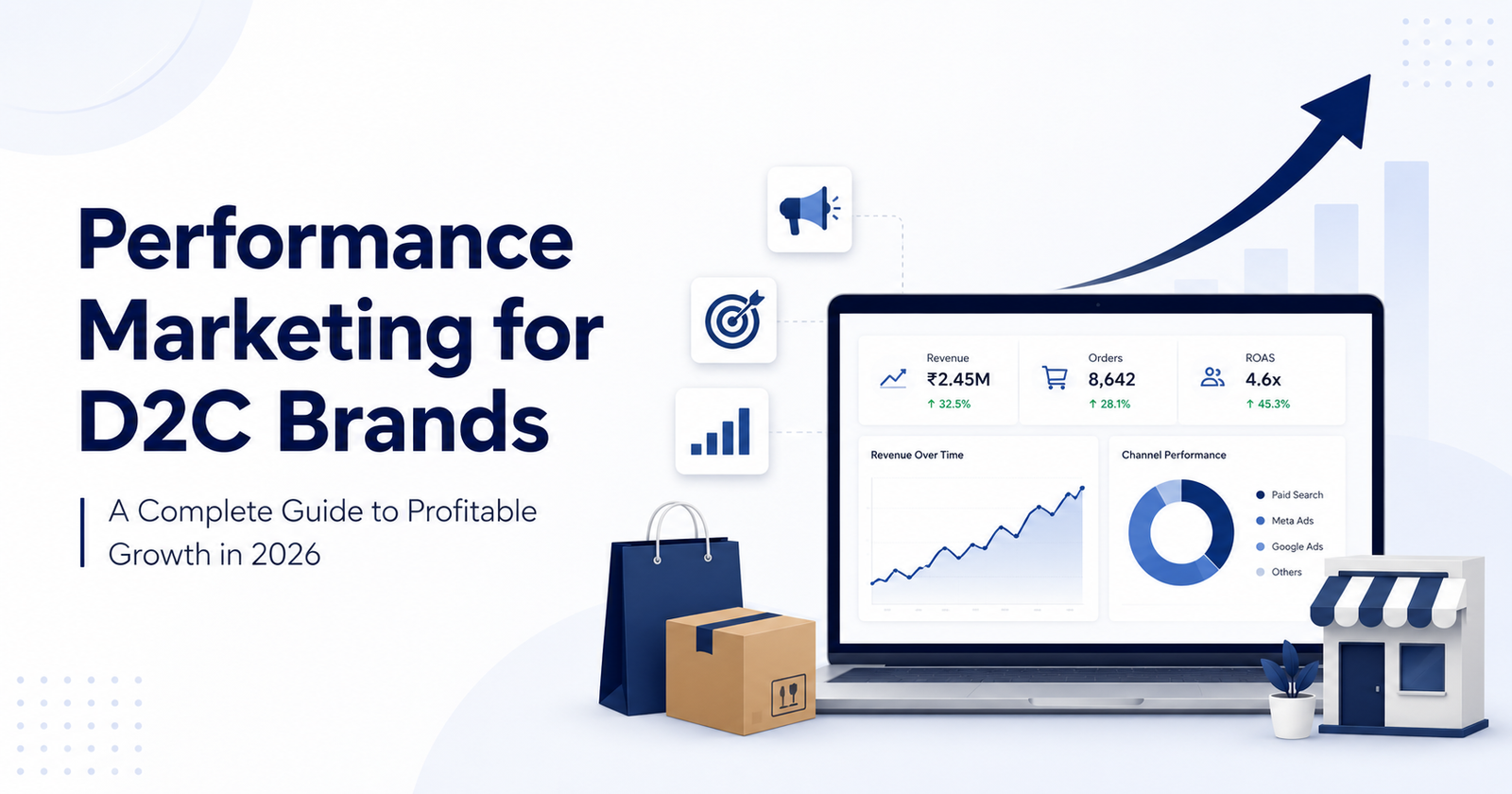
The D2C market has become more competitive than ever.
Thank you for reading this post, don’t forget to subscribe!Launching a Shopify store, running a few Meta Ads, and increasing the advertising budget is no longer enough to build a profitable brand.
Customer acquisition costs are rising, audiences are exposed to more advertisements, competition is increasing, and customers expect better shopping experiences.
This is where performance marketing for D2C brands becomes important.
Unlike traditional marketing, where success may be measured through reach, impressions, or brand awareness, performance marketing focuses on measurable business outcomes such as sales, revenue, customer acquisition cost, conversion rate, and profitability.
However, successful performance marketing is not simply about generating a high ROAS.
A D2C brand needs a complete growth system connecting advertising, creatives, targeting, website experience, tracking, retention, and unit economics.
In this guide, we will explain how D2C brands can use performance marketing to build sustainable and profitable growth in 2026.
In 2026, performance marketing for D2C brands should focus on profitability instead of revenue or ROAS alone.
What Is Performance Marketing for D2C Brands?
Performance marketing is a data-driven digital marketing approach where campaigns are optimized around measurable results.
For D2C businesses, these results usually include:
- Website purchases
- Revenue
- Customer acquisition cost
- Return on ad spend
- Conversion rate
- Average order value
- Customer lifetime value
- Repeat purchases
- Contribution margin
Instead of focusing only on how many people saw an advertisement, performance marketing asks a more important question:
Did the marketing activity generate profitable business growth?
For example, generating ₹10 lakh in revenue from advertisements may look impressive.
But if the brand spends heavily on advertising, discounts, shipping, returns, packaging, payment gateway charges, and product costs, the actual profit could be much lower.
Therefore, performance marketing should focus on both growth and profitability.
Why Performance Marketing Matters for D2C Brands
D2C brands operate differently from traditional retail businesses.
They usually sell directly through their websites and rely heavily on digital channels to acquire customers.
This means every part of the customer journey can influence profitability.
A customer may:
See an Instagram advertisement → Visit the website → Explore the product → Read reviews → Add the product to cart → Leave → See a retargeting advertisement → Return → Purchase.
Performance marketing helps brands understand and optimize this complete journey.
Meta and Google Ads play an important role in performance marketing for D2C brands, but advertising is only one part of the growth system.
Instead of guessing what works, businesses can identify which campaigns, audiences, creatives, products, and landing pages actually generate revenue.
The Core Performance Marketing Funnel for D2C Brands
A strong D2C performance marketing strategy usually contains three major stages.
1. Customer Acquisition
The first stage is bringing potential customers into the brand ecosystem.
Popular acquisition channels include:
- Meta Ads
- Google Ads
- YouTube
- Influencer marketing
- Search engine optimization
- Affiliate marketing
For many D2C brands, Meta Ads and Google Ads remain important paid acquisition channels.
The objective is not simply to generate traffic.
The objective is to attract users who are most likely to become customers.
The best performance marketing for D2C brands approach starts with understanding CAC, AOV, margins, LTV, and break-even ROAS.
2. Conversion
Driving traffic is only half the job.
Once users reach the website, the website must convince them to purchase.
Conversion optimization includes improving:
- Product pages
- Website speed
- Product photography
- Product descriptions
- Reviews
- Trust signals
- Offers
- Checkout experience
- Mobile usability
- Calls to action
Even excellent advertising campaigns can fail when the website experience is poor.
This is why performance marketing and Conversion Rate Optimization (CRO) should work together.
Businesses investing in performance marketing for D2C brands should continuously test creatives, offers, audiences, and landing pages.
3. Retention
Acquiring the same customer repeatedly through paid advertisements can become expensive.
Successful D2C brands therefore focus on increasing customer lifetime value.
Retention strategies may include:
- Email marketing
- WhatsApp marketing
- Loyalty programs
- Repeat purchase offers
- Product recommendations
- Subscription models
- Retargeting
- Post-purchase communication
A customer who buys multiple times can significantly improve the overall profitability of a brand.
The Most Important Performance Marketing Metrics for D2C Brands
Performance marketers track many metrics, but some are more important than others.
1. Customer Acquisition Cost (CAC)
Customer Acquisition Cost represents how much a brand spends to acquire one new customer.
A simple formula is:
CAC = Total Marketing Spend ÷ Number of New Customers
For example:
Marketing spend = ₹1,00,000
New customers = 500
CAC = ₹200
Reducing CAC while maintaining customer quality can improve profitability.
When implemented correctly, performance marketing for D2C brands can create sustainable customer acquisition while protecting profitability.
2. Return on Ad Spend (ROAS)
ROAS measures how much advertising revenue is generated for every rupee spent.
ROAS = Revenue Generated from Ads ÷ Ad Spend
If a company spends ₹1 lakh and generates ₹4 lakh in attributed sales, its ROAS is 4X.
However, ROAS should never be analyzed alone.
A 4X ROAS may be profitable for one brand and unprofitable for another depending on margins and operational costs.
3. Average Order Value (AOV)
Average Order Value represents how much a customer spends per transaction.
AOV = Total Revenue ÷ Total Orders
Brands can increase AOV through:
- Product bundles
- Buy-more-save-more offers
- Cross-selling
- Upselling
- Free shipping thresholds
- Combo packs
Higher AOV can allow brands to afford higher customer acquisition costs.
4. Conversion Rate
Your website conversion rate tells you what percentage of website visitors complete a purchase.
For example, if 10,000 people visit your website and 200 purchase, your conversion rate is 2%.
Conversion rate can be improved through better:
- Website UX
- Product pages
- Offers
- Product information
- Reviews
- Checkout flow
- Loading speed
- Trust signals
5. Customer Lifetime Value (LTV)
Customer Lifetime Value estimates how much revenue or profit a customer generates throughout their relationship with the brand.
Brands with strong repeat purchase behavior can afford to invest more aggressively in acquisition.
For example, skincare, food, wellness, and personal care brands often have strong repeat purchase opportunities.
6. Contribution Margin
Contribution margin is one of the most important metrics when evaluating whether growth is actually profitable.
A simplified calculation may include:
Revenue
– Product cost
– Discounts
– Shipping
– Packaging
– Payment gateway fees
– Returns/RTO
– Advertising cost
What remains gives the brand a better picture of actual profitability.
Why ROAS Alone Is Not Enough
One of the biggest mistakes D2C brands make is optimizing everything around ROAS.
Consider two brands.
Brand A
Revenue: ₹5,00,000
Ad Spend: ₹1,00,000
ROAS: 5X
Brand B
Revenue: ₹5,00,000
Ad Spend: ₹1,50,000
ROAS: 3.33X
At first glance, Brand A appears significantly better.
However, if Brand A uses aggressive discounts, has low margins, high shipping costs, and high return rates, its actual profitability may be lower.
Performance marketing must therefore evaluate:
ROAS + CAC + AOV + margins + operational costs + customer lifetime value.
The objective should be profitable growth, not simply attractive advertising numbers.
Meta Ads for D2C Brands
Meta Ads remain one of the most popular customer acquisition channels for ecommerce brands.
They allow businesses to reach potential buyers across platforms such as Facebook and Instagram.
A strong Meta Ads strategy usually includes multiple components.
Creative Testing
Creative is often one of the biggest drivers of campaign performance.
Brands should continuously test:
- UGC videos
- Product demonstration videos
- Problem-solution ads
- Testimonials
- Founder videos
- Static product ads
- Comparison ads
- Lifestyle creatives
- Offer-based advertisements
Different creatives work for different audiences.
Continuous testing helps brands discover winning messaging angles.
Meta provides advertising tools that allow ecommerce brands to reach and retarget audiences across Facebook and Instagram.
Audience Testing
D2C brands can test different audience types such as:
- Broad audiences
- Interest-based audiences
- Website visitors
- Social media engagers
- Customer lists
- Lookalike audiences
However, targeting alone cannot fix a weak offer or poor creative.
Creative quality, messaging, website experience, and product-market fit often play equally important roles.
Retargeting
Many customers do not purchase during their first website visit.
Retargeting campaigns help bring them back.
Potential retargeting audiences include:
- Website visitors
- Product viewers
- Add-to-cart users
- Checkout users
- Instagram engagers
- Previous customers
Retargeting messaging can include reviews, product benefits, FAQs, offers, or urgency.
Google Ads for D2C Brands
Google Ads allows brands to capture users who are actively searching for products.
Google Analytics can help brands understand website traffic, acquisition channels, user behaviour, and conversions.
Important campaign types can include:
Google Search Ads
These target keywords people search on Google.
For example:
“best cabin luggage in India”
“organic shampoo for hair fall”
“premium skincare products”
Search campaigns can work particularly well when customers already have strong purchase intent.
Google Shopping Campaigns
Shopping ads display products directly in search results with images and pricing.
They can be highly relevant for ecommerce brands because users can compare products before visiting the website.
Performance Max Campaigns
Performance Max allows advertisers to run campaigns across multiple Google properties using automation and machine learning.
However, brands still need strong:
- Product feeds
- Creatives
- Landing pages
- Conversion tracking
- Audience signals
Automation cannot compensate for poor fundamentals.
Creative Strategy: The Engine Behind D2C Growth
Performance marketing campaigns depend heavily on creative quality.
Customers are exposed to hundreds of advertisements online.
Your creative needs to stop attention and communicate value quickly.
A high-performing D2C creative usually answers:
What is the problem?
Identify the customer’s pain point.
What is the solution?
Show how the product addresses the problem.
Why should customers trust you?
Use testimonials, reviews, demonstrations, certifications, or social proof.
Why should they buy now?
Communicate the offer, value proposition, or urgency.
What should they do next?
Use a clear call to action.
Website CRO: Turn More Traffic Into Customers
Imagine spending ₹3 lakh every month on advertising.
Instead of increasing the advertising budget, improving your conversion rate could sometimes generate additional sales from the same traffic.
This is why CRO should be a major part of any D2C performance marketing strategy.
Important CRO elements include:
Product Images
Use high-quality photos showing:
- Multiple product angles
- Product details
- Product usage
- Lifestyle context
- Product size or scale
Product Descriptions
Product descriptions should focus on customer benefits rather than only technical features.
Customer Reviews
Reviews help reduce customer hesitation and increase trust.
Mobile Optimization
A large portion of D2C traffic often comes from mobile devices.
Product pages should therefore be fast, easy to navigate, and simple to purchase from.
Checkout Experience
Avoid unnecessary steps during checkout.
Make payment options clear and reduce friction wherever possible.
Improve Average Order Value
Increasing AOV can significantly improve D2C economics.
Suppose your CAC is ₹400.
If your average order value is ₹800, customer acquisition may be difficult.
But if you increase AOV to ₹1,400 through bundles and upsells, you may have more room to acquire customers profitably.
Strategies include:
- Bundle offers
- Product combos
- Quantity discounts
- Upsells
- Cross-sells
- Free shipping thresholds
- Complementary products
Reduce Customer Acquisition Cost
CAC can rise when competition increases or campaigns lose effectiveness.
Brands can reduce CAC by improving multiple parts of the funnel.
Test More Creatives
Advertising fatigue can reduce performance.
Refresh creatives regularly.
Improve Website Conversion Rate
Better conversion means more customers from the same traffic.
Strengthen Your Offer
Customers need a compelling reason to choose your brand.
Improve Product Positioning
Clearly communicate why your product is different.
Build Organic Traffic
SEO, social content, and creator partnerships can reduce long-term dependence on paid advertising.
Build Better Retention
Performance marketing should not stop after a customer purchases.
Retention can significantly improve profitability.
Brands can use:
- WhatsApp campaigns
- Email automation
- Replenishment reminders
- Loyalty rewards
- New product launches
- Personalized offers
- Cross-selling
- Subscription programs
For products that customers purchase repeatedly, retention becomes even more valuable.
Track the Entire Customer Journey
Accurate tracking is essential for performance marketing.
Brands should properly configure tools such as:
- Meta Pixel
- Meta Conversion API
- Google Analytics
- Google Ads conversion tracking
- Google Merchant Center
- Ecommerce analytics
- CRM tracking
Tracking helps businesses understand where customers are coming from and which marketing channels generate results.
Without reliable data, campaign optimization becomes guesswork.
Common Performance Marketing Mistakes D2C Brands Should Avoid
1. Scaling Campaigns Too Fast
Increasing budgets aggressively before identifying profitable campaigns can increase losses.
Test first, validate economics, and scale gradually.
2. Focusing Only on ROAS
ROAS is important, but profitability depends on much more.
3. Ignoring Creative Fatigue
Winning advertisements do not perform forever.
Continuous creative testing is necessary.
4. Sending Every Ad to the Homepage
Campaign traffic should often be directed to the most relevant product or landing page.
5. Ignoring Mobile Experience
A poor mobile shopping experience can significantly reduce conversions.
6. Constantly Changing Campaigns
Making too many changes can make performance difficult to evaluate.
7. Scaling Without Understanding Unit Economics
Growth becomes dangerous when brands do not understand their break-even acquisition cost.
A Simple D2C Performance Marketing Framework for 2026
A profitable growth strategy can be divided into five steps.
Step 1: Understand Your Unit Economics
Know your:
- Product margins
- CAC
- AOV
- Contribution margin
- Return rate
- Shipping cost
- Repeat purchase rate
- Break-even ROAS
Step 2: Build Strong Tracking
Ensure your advertising and analytics systems are collecting reliable data.
Step 3: Test Creatives and Offers
Find the messages that resonate with customers.
Step 4: Improve Website Conversion
Turn more advertising traffic into customers.
Step 5: Scale Profitable Campaigns
Once the economics work, gradually increase campaign budgets.
Performance Marketing Is a System, Not Just Advertising
A common misconception is that performance marketing simply means running Facebook or Google Ads.
In reality, successful D2C growth requires multiple systems working together:
Product + Offer + Messaging + Creative + Advertising + Website + Tracking + Retention + Unit Economics
If one part of this system is weak, performance can suffer.
For example:
Great ads + weak website = poor conversions.
Strong website + weak creative = expensive traffic.
High ROAS + weak margins = poor profitability.
Good acquisition + no retention = constant dependence on paid advertising.
The strongest D2C brands optimize the complete growth system rather than one isolated metric.
How UpscaleEra Helps D2C Brands Scale Profitably
At UpscaleEra, we approach D2C growth as a connected performance system rather than simply running advertisements.
Our focus is on improving the complete customer journey through:
- Performance marketing
- Meta Ads management
- Google Ads
- Creative strategy
- Conversion-focused websites
- Shopify development
- Landing page optimization
- Analytics and tracking
- AI automation
- Growth strategy
The objective is simple:
Generate better customers, improve conversions, and build profitable growth rather than simply increasing ad spend.
A successful performance marketing for D2C brands strategy connects paid advertising, creative testing, website CRO, tracking, and retention.
Final Thoughts
Performance marketing for D2C brands in 2026 is no longer about finding one winning advertisement and continuously increasing the budget.
The brands that scale sustainably focus on the complete business equation.
They understand customer acquisition costs.
They monitor margins.
They continuously test creatives.
They improve conversion rates.
They increase average order values.
They retain existing customers.
And most importantly, they measure profitability alongside growth.
If your D2C brand is generating traffic or revenue but struggling to scale profitably, the problem may not be a single campaign.
It may be the entire growth system.
A structured performance marketing strategy can help identify those gaps and turn marketing spend into sustainable business growth.