
How to reduce RTO and COD losses for Indian D2C brands
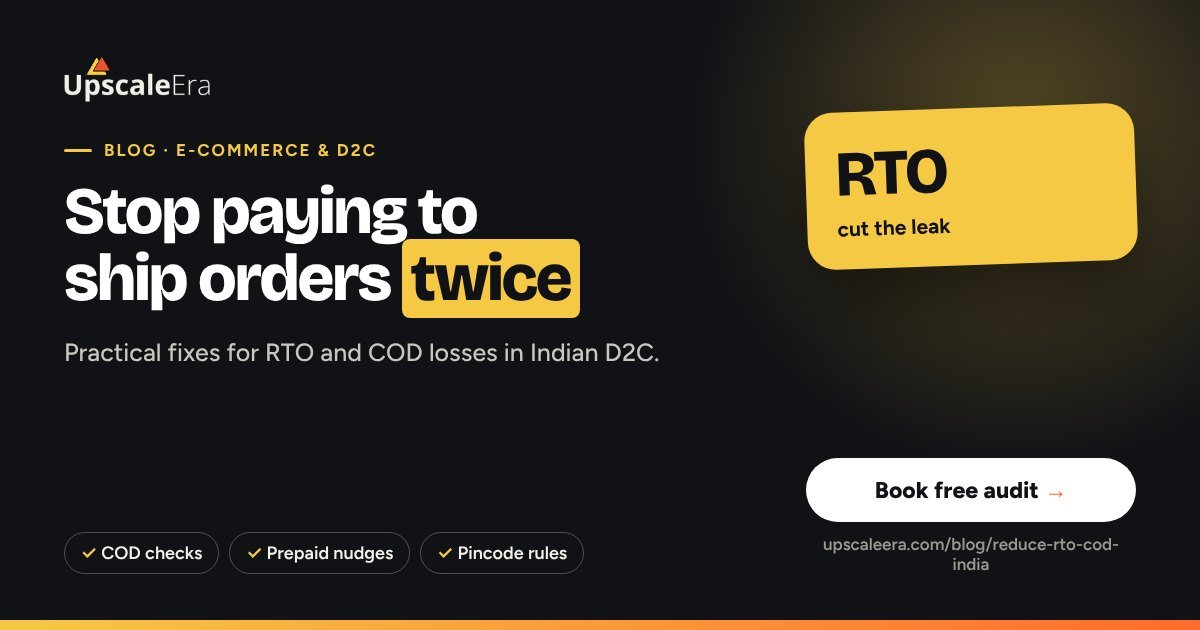
RTO happens when an order is shipped but not delivered and comes back, usually from COD orders where the buyer changes their mind, gives a wrong address or is unreachable. Reduce it by confirming COD orders on WhatsApp before dispatch, rewarding prepaid payment, validating addresses and phone numbers, applying stricter rules to high-risk pincodes, shipping faster, and making product pages honest so expectations match.
Key takeaways
- Every RTO costs forward and reverse shipping, plus blocked or damaged stock.
- Confirm COD orders before shipping, not after.
- Make prepaid the easy, rewarded choice.
- Use pincode and customer history to set COD rules.
- Faster delivery means fewer changed minds.
What an RTO really costs
You pay forward shipping, often reverse shipping, packaging, possible damage to stock, plus the ad cost that created the order. That cost belongs in CM2. A modest RTO rate on COD orders can wipe out the margin on many delivered orders, which is why fixing RTO is often the fastest profit win.
10 fixes that work
- WhatsApp COD confirmation with one-tap confirm/cancel before dispatch.
- Prepaid incentive: a small discount, free shipping or a gift for prepaid.
- Partial COD: take a small advance online for high-risk orders.
- Address validation with landmark and pincode checks at checkout.
- Phone verification by OTP for COD.
- Pincode risk rules: disable COD or require partial payment where RTO is historically high.
- Customer history: block COD for repeat refusers.
- Faster dispatch and a reliable courier mix for each region.
- Delivery updates on WhatsApp so buyers expect the courier.
- Honest product pages: real photos, size guides and reviews reduce “not as expected”.
Track it properly
| Metric | Cut by |
|---|---|
| RTO % of shipped orders | Payment mode, pincode, courier, product, campaign |
| Prepaid share | Campaign and creative |
| Cost per delivered order | Campaign |
Optimise ads on delivered orders where you can. A campaign with lower ROAS on placed orders may win on delivered ones.
Common mistakes to avoid
- Shipping COD orders without any confirmation
- Offering COD everywhere regardless of history
- Measuring ads on placed orders only
- Vague product pages that create “not as expected” refusals
- Slow dispatch that gives buyers time to change their mind
Your 30-day action plan
- Week 1: measure RTO % by payment mode, pincode, courier and product
- Week 2: launch WhatsApp COD confirmation before dispatch
- Week 3: add a prepaid incentive and pincode-based COD rules
- Week 4: compare RTO % and cost per delivered order with the baseline
Want a second pair of eyes? Book a free Growth Leak Audit and we will review your numbers with you.
Our D2C growth system, built on the CAC Ceiling Method™: spend only grows while each customer costs less than your margin can carry. Judged on contribution margin, not ROAS.
See how it works Breakeven ROAS calculatorHow we handle this at UpscaleEra
RTO eats the margin your CAC ceiling depends on. In Profit Scale we measure revenue after returns and RTO, not gross orders, and we only scale campaigns whose net cost per customer stays under the ceiling. COD confirmation and pin-code rules are part of the setup, not an afterthought.
Frequently asked questions
What is RTO in e-commerce?
Return to origin: a shipped order that was not delivered and returns to the seller, often due to refusal, a wrong address or an unreachable buyer.
Should I remove COD completely?
Rarely. COD can lift conversion. Restrict it where risk is high and reward prepaid instead.
Do COD confirmation calls help?
Confirmation before dispatch, by WhatsApp or call, catches many cancellations before you pay shipping.
Which ad metric should I optimise?
Ideally delivered or prepaid orders. Placed orders with high RTO overstate performance.