
Lead generation strategy for Indian service businesses: the 2026 playbook
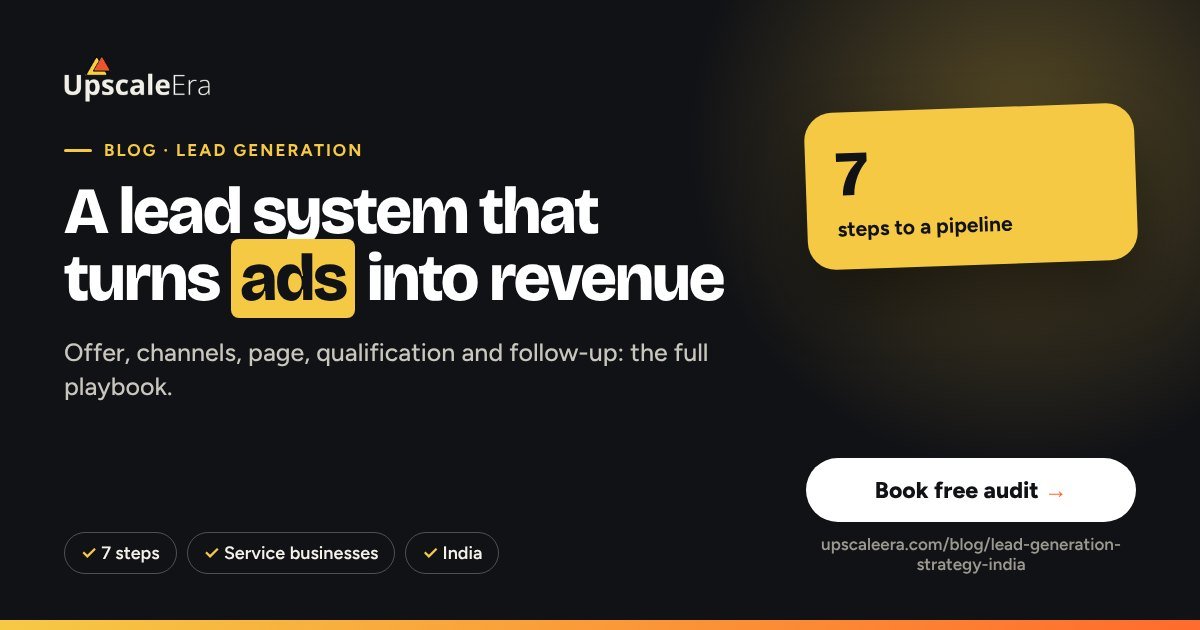
A lead generation strategy that works in India has seven linked parts: a clear offer for one ideal customer, the right channel for their intent (Google search for active demand, Meta for new demand), a focused landing page, qualifying questions, a first call within five minutes, a CRM-driven follow-up sequence, and measurement on cost per sale rather than cost per lead. Most businesses fix ads first; the biggest gains usually come from qualification and follow-up.
Key takeaways
- Define one ideal customer and one offer before choosing channels.
- Match the channel to intent: Google captures demand, Meta creates it.
- Qualify inside the form so sales calls the right people first.
- Speed and follow-up usually move revenue more than ad tweaks.
- Judge every campaign on cost per qualified lead and cost per sale.
1. Start with the offer, not the ads
An ad can only amplify an offer. Write down who you serve (industry, size, city, budget), the problem they will pay to solve, and the first step you want them to take. “Book a free 30-minute audit” or “Get a site-visit slot this weekend” converts better than “Contact us” because it tells the buyer exactly what happens next.
Test the offer by asking: would your best existing client have said yes to this, in this wording, on day one? If not, change the offer before spending on ads.
2. Pick channels by buyer intent
| Situation | Start with | Add later |
|---|---|---|
| People already search for your service | Google Search ads + SEO | Meta retargeting |
| Visual or new category, local reach | Meta ads (Facebook + Instagram) | Google brand search |
| High-value B2B, small buyer list | LinkedIn + outbound | Retargeting, webinars |
| Local footfall business | Google Business Profile + Maps | Local Meta ads |
For a deeper comparison read Meta ads vs Google ads for lead generation.
3. Build one landing page per offer
Send ads to a page built for one action, not your homepage. The page should repeat the ad's promise in the headline, show proof (results, reviews, logos), answer the top three objections and ask for the minimum information needed. Every extra link is an exit.
4. Qualify before sales picks up the phone
Add two or three questions that separate buyers from browsers: budget range, timeline, location or company size. Route answers into tiers in your CRM so the hottest leads are called first. Qualification lowers lead volume slightly and raises revenue per lead, which is the trade you want.
5. Respond in minutes, follow up for days
Interest fades fast. Call new leads within five minutes during working hours, send an instant WhatsApp confirmation, and run a follow-up sequence over the next 7 to 14 days with a different reason to talk each time. See why speed to lead matters.
6. Close the loop with your CRM
Mark every lead's outcome: contacted, qualified, meeting, won, lost (with reason). Send qualified and won events back to Meta (Conversions API) and Google (offline conversions) so the algorithms find more people like your real buyers, not just form-fillers.
7. Measure what predicts revenue
| Metric | Why it matters |
|---|---|
| Cost per qualified lead | Filters out junk that cheap CPL hides |
| Lead-to-meeting rate | Shows follow-up and lead quality together |
| Cost per sale (CAC) | The number your profit depends on |
| Speed to first contact | The cheapest lever to improve |
Work out your own numbers with the free cost per sale calculator.
Common mistakes to avoid
- Running ads before the offer is clear
- Sending all traffic to the homepage
- Judging campaigns on cost per lead only
- No owner for each lead, so follow-up depends on memory
- Changing campaigns daily before they have enough data
Your 30-day action plan
- Week 1: write the ideal-customer profile and one offer; set up CRM stages and tracking
- Week 2: build one landing page with proof, FAQ and 2 to 3 qualifying questions
- Week 3: launch one Google Search or Meta campaign with 3 to 5 creatives; call every lead within 5 minutes
- Week 4: review cost per qualified lead and lead-to-meeting rate; keep winners, fix the weakest step
Want a second pair of eyes? Book a free Growth Leak Audit and we will review your numbers with you.
Our lead-generation system, built on the Sales-Signal Loop™: your sales feedback trains the ads every week. Judged on qualified appointments, not cost per lead.
See how it works Cost per sale calculatorHow we handle this at UpscaleEra
This playbook is our Growth Leak Map™ in practice: offer, message, acquisition, capture, qualification, follow-up and tracking, checked in that order. On Predictable Pipeline accounts the Sales-Signal Loop ties it together: sales outcomes go back into the ad platforms every week, and the budget follows the leads that become meetings.
Frequently asked questions
What is the best lead generation channel in India?
There is no single best channel. Google Search suits services people already look for; Meta suits visual offers and new demand; LinkedIn suits high-value B2B. Most growing businesses combine two.
How long does a lead generation system take to work?
Setup and testing usually take the first 30 days, and results become stable enough to scale in 60 to 90 days, depending on budget and sales cycle.
Should I buy leads from lead vendors?
Shared or bought lists are usually low intent and contacted by many competitors. Owned channels with your own qualification give better long-term economics.
How many qualifying questions should a form have?
Two or three is a good starting point: enough to sort leads, short enough not to scare good buyers away.