
Meta instant forms vs landing pages: which gets better leads?
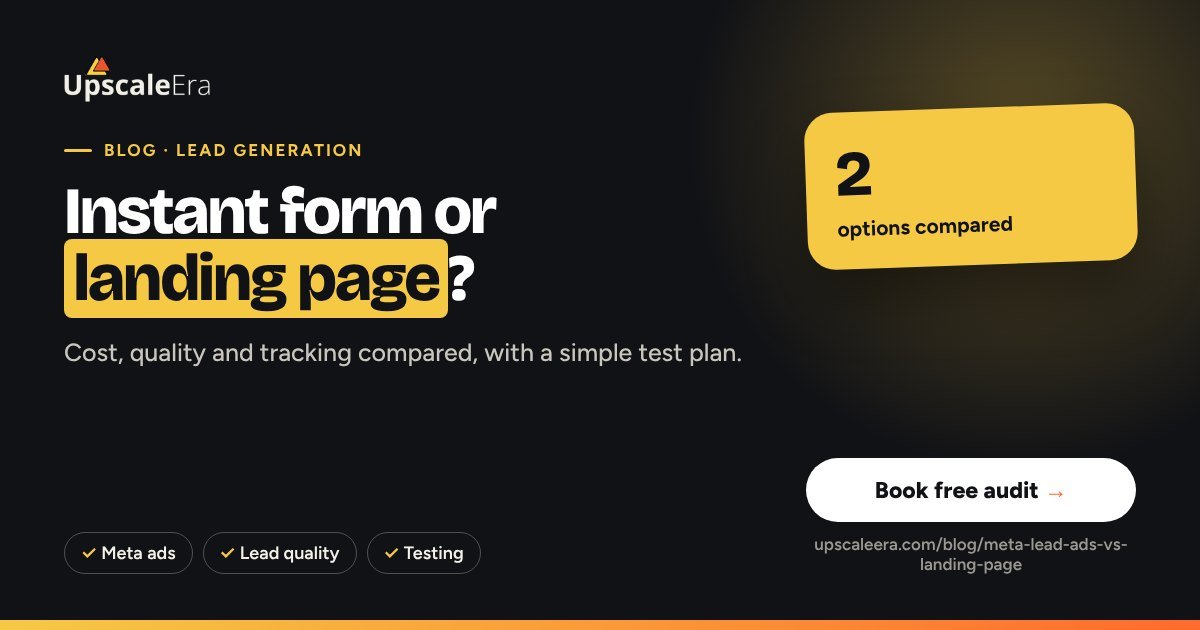
Meta instant forms usually give cheaper leads because people never leave Facebook or Instagram and their details are pre-filled, but intent is often lower. Landing pages cost more per lead but let you explain the offer, show proof and qualify, so leads are usually better informed. Use higher-intent instant forms with qualifying questions for speed and volume; use landing pages for higher-value or complex offers; test both on cost per qualified lead.
Key takeaways
- Instant forms: cheaper, faster, lower intent.
- Landing pages: more context, more friction, often higher intent.
- Judge both on cost per qualified lead, not CPL.
- Instant forms need fast follow-up more than anything.
- Feed CRM outcomes back to Meta whichever you choose.
Side by side
| Instant form | Landing page | |
|---|---|---|
| Cost per lead | Usually lower | Usually higher |
| Lead intent | Mixed | Higher on average |
| Room to explain | Small intro screen | Full page, proof, FAQ |
| Load speed | Instant | Depends on your site |
| Tracking | Native in Meta | Needs Pixel + CAPI |
When to use each
- Instant forms: local services, simple offers, callback requests, events, teams that call back within minutes.
- Landing pages: higher prices, B2B, offers that need explanation, or when you also want SEO and retargeting value.
Make instant forms better
- Choose the higher-intent form type with a review screen.
- Add a short qualifying question or two.
- Use the intro to state price range and who it's for.
- Sync leads to the CRM in real time and call fast.
- Send qualified-lead events back via Conversions API.
A fair test
Run both versions with the same creative and audience, split budget evenly, and wait until each has enough leads to compare. Decide on cost per qualified lead and, if your cycle allows, cost per sale.
Common mistakes to avoid
- Comparing the two on CPL only
- Using the “more volume” form with no questions for a high-value offer
- Running the test on different creatives or audiences
- Stopping the test after a day or two
- Ignoring how fast each type was followed up
Your 30-day action plan
- Week 1: set up both versions with identical creative and audience
- Week 2: run with equal budget; log every lead's outcome in the CRM
- Week 3: keep running until each has enough leads to compare
- Week 4: decide on cost per qualified lead and move budget to the winner
Want a second pair of eyes? Book a free Growth Leak Audit and we will review your numbers with you.
Our lead-generation system, built on the Sales-Signal Loop™: your sales feedback trains the ads every week. Judged on qualified appointments, not cost per lead.
See how it works Cost per sale calculatorHow we handle this at UpscaleEra
We don’t pick a side in advance. We run both, add one or two qualifying questions, and judge them on cost per qualified appointment rather than cost per lead. Through the Sales-Signal Loop, the “qualified” result goes back to Meta, so whichever path wins keeps improving.
Frequently asked questions
Are Facebook lead ads worth it?
Yes, when paired with qualification and fast follow-up. Without them they often produce many low-intent leads.
Can I use both at once?
Yes. Many accounts run instant forms for volume and landing pages for higher-intent audiences.
Why is my landing page CPL so high?
Check page speed, message match with the ad, and form length first.
Which tracks better?
Instant forms are tracked natively; landing pages need Pixel and Conversions API set up correctly.